
Let's Stop Underestimating Scientists
There is no box we have to fit into. We can be our whole, deep, complex, multitasking selves, and we can build a version of science that allows us to be humans first.

I’ve had a “nontraditional” path in science. I went to community college, dropped out, went back, gained my undergraduate research experience late, started my PhD at 28, had a baby in my second year, and then started a political organization in my third year. I’m used to being told that I “can’t” or “won’t be able to” do something. But at the end of the day, humans are flexible, resilient, and have the gumption to do a lot of rising to the occasion when they have to.
Over the weekend, Holden Thorp, PhD and EiC of Science, gave a talk at the Biophysical Society’s annual meeting. This talk comes on the heels of some back and forth between us—which I think is good! To be clear, we should be having conversations in the public square about how to meet the moment. I wish we would have started having these conversations a year ago.
Below is a slide from Thorp’s talk. In all of his recent commentary, Thorp has set up a false dichotomy, which I view as a fundamental flaw in his arguments defending how AAAS and other legacy science organizations have met the moment. Frankly, I’m writing about it because I’m annoyed. So, consider this my public statement about Thorp’s talk.
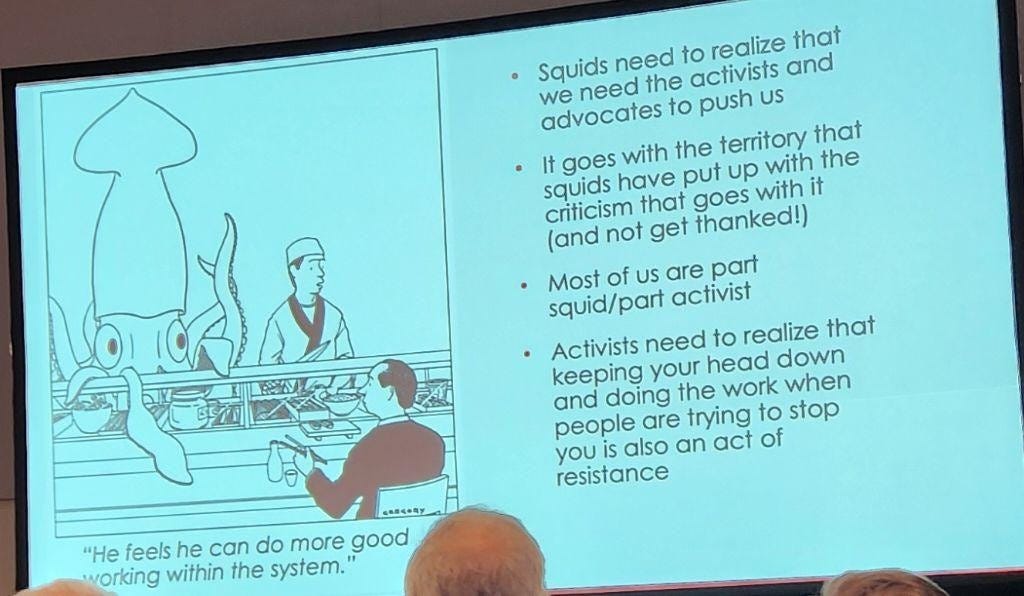
Despite the third bullet point that “Most of us are part squid/part activist”, Thorp has repeatedly set up the dichotomy of “we (AAAS) play inside ball” and “they (SUFS, et al.,) play outside ball. “Ball” here being methods of engaging politicians with regard to dealing with Trump’s attacks on science and democracy. This is fundamentally incorrect.
From July to Dec 2025, SUFS held over 100 meetings with Congress. We’ve also held closed door briefings, policy summits, we support legislation, we have a government relations team on the Hill, and we have an organizational arm for electoral work. This is, of course, in addition to continued direct action mobilization, strategic communications that have made over 16 BILLION earned media impressions, and other “outside” ball tactics. So, the idea that it’s one or the other—inside or outside—is simply false.
Further, the idea that one must EITHER keep one’s head down OR engage in activism, is a false dichotomy. I’ve been working to finish my PhD at an R1 institution while building Stand Up for Science. I submitted an NIH grant, proposed my dissertation, submitted two first author papers, contributed to three other manuscripts, mentored two undergraduates, and taught a summer research class in the past year. I’m not saying this to toot my own horn, I’m saying it to show that multitasking is possible. But more importantly, activism comes in many forms— everyone doesn’t need to start an organization.
The federal scientists who risked their jobs to blow the whistle at the NIH, NSF, EPA, NASA, FEMA, VA, and CDC, the professors who find ways to support their graduate students’ work in targeted areas, the HB1 scholar who drops micro flyers around campus, the post-doc who calls their Congress critters every day on their way into the lab: this is activism.
Dr. Jenna Norton said it perfectly: now is the moment for people in power to get up and do a little multitasking for the folks in our scientific ecosystem who are most at risk because of the attack on science and democracy. It’s a privilege to get to keep your head down while ICE is kidnapping & killing people in the streets. It’s a privilege to study something that isn’t targeted by this admin. It’s a privilege to be a white male citizen with tenure or position in this country.
Scientists everywhere are struggling to do their work because they or someone they love could get picked up by ICE. So, while we are in the street standing up for science and the scientists who can’t risk standing up for theirselves…you’re what? In your lab? Keeping your head down in “resistance”?**
Maybe science organizations don’t want to play outside game. Sure, that’s fine. I understand. But, apologize to your members for not meeting the moment with the seriousness it deserved. Then, support some activists who are doing the dirty work you can’t be bothered to do. The approach of doubling down and disparaging our efforts while complaining about not being thanked is silly goose behavior. Get serious. This is fascism.
Not a SINGLE science organization or society has donated to Stand Up for Science.
Holden Thorp’s stance upholds the status quo; a version of science that we don’t have to go back to, with an underlying assumption that scientists are scientists first. This framework posits that scientists don’t have the breadth and capacity for real human engagement because we are “too busy with our science”. It’s the same attitude that drove comments of people telling me that I didn’t have enough research experience to get a PhD, that I would end up divorced if I went to grad school, that having a baby would wreck my career ambitions, and that I would need to drop out of my PhD program to manage Stand Up for Science.
There is no box we have to fit into. We can be our whole, deep, complex, multitasking selves, and we can build a version of science that allows us to be humans first. But we aren’t going to be able to make this happen by keeping our heads down. Welcome to the fight, dorks.
**Scientists who are in targeted groups are NOT included in this statement. If you’re at risk, by all means, do what you need to do. But there are many people who are in privileged positions who should be fighting for you, that are not.
Thanks, Colette. The cartoon was making the very same point you are in a lighthearted way. The first point is to tell the "squids" that activists making them uncomfortable is how it works. The second bullet was awkwardly worded and I will fix. I said when I was presenting it that the "squids" need to accept criticism and do not deserve to be thanked for just doing what they are supposed to do (or a portion of it, in your view). I do disagree with you that every scientists is obligated to engage. Many are already overwhelmed with the demands of science as it is. I agree many, like you and many others, can do so and am grateful for their engagement.
Although NIH, NSF and other acronyms are well understood, I have no idea of the meaning of SUFS. Please explain. Also, "Everyone doesn't . . ." is ambiguous. Do you mean: No one does, or Only some do . . .?